
When Mohammad Rafi Struggled With Marathi Pronunciation: The Inspiring Story Behind the Timeless Children’s Song Prakashatale Tare Tumhi

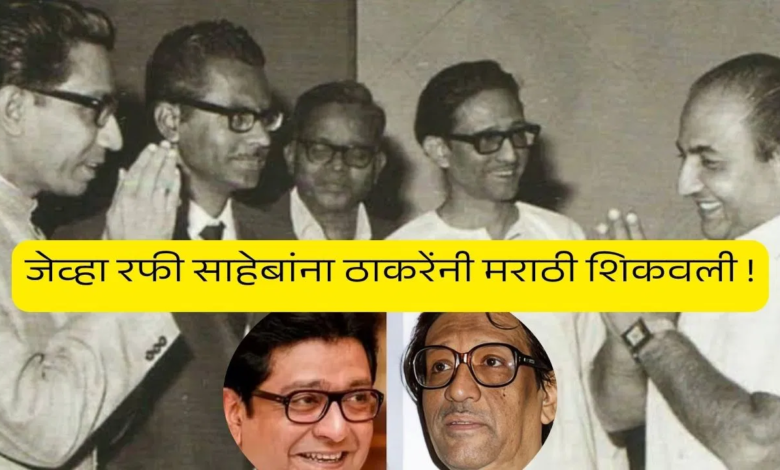
Legendary playback singer Mohammad Rafi recorded numerous songs across various Indian languages, and his memorable contributions to Marathi music were born out of his close friendship with composer Shrikant Thackeray father of MNS chief Raj Thackrey . In his book Jasa Ghadla Tasa, Thackeray shared the fascinating, behind-the-scenes story of how he taught the musical maestro to master Marathi pronunciation for a legendary children’s song.
A Friendship Rooted in Music
Blessed with a divine voice, Mohammad Rafi shared a deep, famous bond with the Thackeray family. Shrikant Thackeray composed several immortal Marathi melodies and often collaborated with Rafi. Once, Rafi developed such a deep passion for Marathi songs that he would frequently ask Thackeray when they were recording next. Thackeray, however, preferred spacing out projects to maintain quality, noting how an over-saturated release schedule could hurt an artist’s previous records.
The Challenge of the Marathi Letter ‘Cha’ (च)
Lyricist Umakant Kanekar—who worked at Siemens in Worli and traveled from Thane whenever called upon—brought a children’s song packed with words featuring the Marathi sound “cha” (च). This created a major hurdle during recording, as Rafi struggled to get the precise pronunciation right.
Thackeray recalled, “I told Rafi saab to touch his tongue to his teeth while pronouncing ‘cha’. Still, it wasn’t working out.” Even Rafi’s brother-in-law, Zaheer, watched the coaching sessions and humorously asked to learn Marathi too, to which Thackeray replied, “Let me teach him first; I’ll teach you later!”
Connecting Urdu and Marathi Phonetical Sounds
With the recording date fast approaching, Thackeray used a clever linguistic trick. He drew parallels with familiar Urdu words containing the soft sound, giving examples like jahin, zarurat, zarina, zamanat, and janana. He explained that the physical articulation required for these sounds mirrors how the Marathi “cha” is pronounced.
“If you want someone else to sing in your language, you must have knowledge of both languages,” Thackeray wrote in his memoir. Thanks to this meticulous coaching, Rafi finally nailed the pronunciation.
The result of this dedication was the immortal children’s classic: “Prakashatale Tare Tumhi Andharavar Rusa, Hasa Mulano Hasa” (You stars of light, frown upon the darkness, smile, children, smile). Today, it remains one of the most beloved and enduring children’s songs in Marathi music history.


Leave a Reply
You must be logged in to post a comment.