

National Award-winning actor Atul Kulkarni, widely recognized for his razor-sharp commentary on socio-political issues, has shared a deeply poignant, metaphorical response regarding the explosive online phenomenon known as the “Cockroach Janata Party” (CJP).
The bizarre political satire campaign—which started after a politician dismissively compared unemployed youth on social media and RTI activists to “cockroaches”—has mutated into a massive digital movement. In just a few days, the satirical “Cockroach Janata Party” gained an unprecedented wave of followers, rapidly outpacing the social media metrics of some of the country’s largest established political organizations.
Using a striking medical analogy, Kulkarni highlighted how the sudden rise of this satirical movement is not a joke, but a clinical symptom of deep-seated public discontent.
The Analogy: A Satirical Party Functioning as a Thermometer
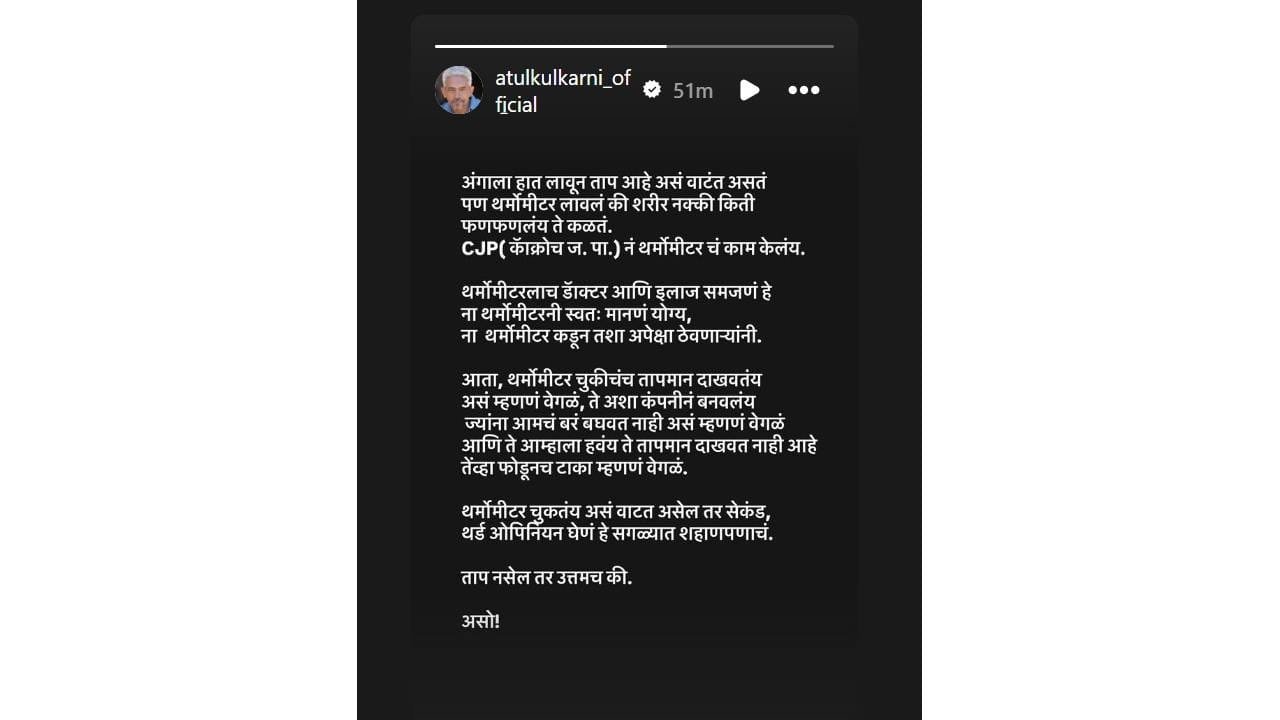
In a thought-provoking post shared across his digital handles, Kulkarni compared the CJP movement to a thermometer, taunting the ruling administration for attacking the symptom rather than curing the systemic disease.
Atul Kulkarni: “You feel like you have a fever when you touch your body, but when you put on a thermometer, you know exactly how much your body is burning. The CJP has done the exact work of a thermometer. It is not right for the thermometer itself to be considered a doctor or a cure—nor should it be treated that way by those expecting a clinical solution from a glass tube.”
The actor went on to dismantle the government’s defensive reactions to the viral movement:
It is one thing to baselessly claim that the thermometer is showing a wrong temperature simply because you don’t like the number. It is entirely futile to argue that the instrument was built by an opposition company or an external entity that doesn’t care about the nation. Striking down the data because it fails to show the comfortable, low temperature you want to see changes nothing about the actual illness.
“If you truly believe the thermometer is wrong,” Kulkarni noted subtly, “the wisest thing to do is take a second or third independent opinion. But it’s always better if you don’t have a fever in the first place.”
-

-

-

-

